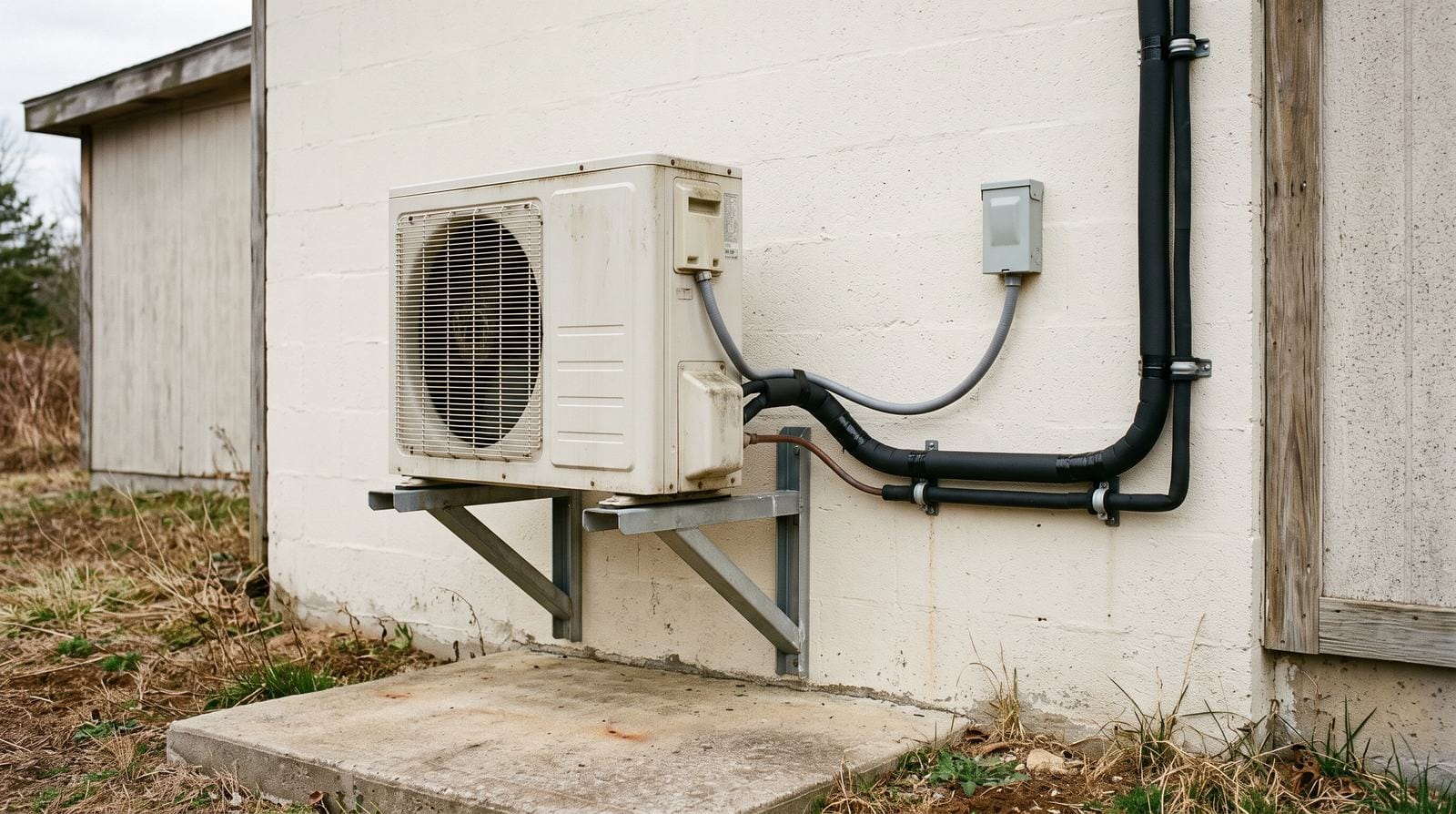
Installation
Heat Pump Installation in Woodstock, GA
Heat pumps do most of the work in this climate and they have gotten a lot better at the cold end. The question worth asking is not whether a heat pump will heat your house in January — it will — but whether your ductwork and your backup heat are sized to let it. That is what we come out to figure out.
What's included
- Load calculation and a capacity check against the local 99.6% heating design temperature
- A straight answer on heat pump versus dual fuel for your address and your fuel situation
- Duct evaluation — a heat pump moves more air at a lower supply temperature and a tight duct system shows it
- Backup heat sized deliberately rather than defaulted to the largest strip kit in the catalogue
- Balance point and, on dual fuel, the switchover set and explained rather than left at the factory number
- Defrost operation and reversing-valve function verified at commissioning
- Permit pulled, inspection scheduled, manufacturer registration filed within 48 hours
- Old equipment hauled away and the refrigerant recovered
How the visit actually goes
We find out what you are heating with now, and what your neighbors are heating with
Whether the gas main runs down your road changes the answer completely. Inside town limits around here, most houses have utility gas. A few miles out, propane and straight electric take over. Those are three different recommendations and we would rather work out which one you are before we quote anything.
We size it against the local design temperature
The published heating design condition for this county is colder than Atlanta's. A correctly sized heat pump here has a thermal balance point well below the factory-default switchover, which means a system left on the default hands load to the backup while the heat pump still has capacity to give.
We look hard at the ductwork before we set a box down
A heat pump delivers a lower supply temperature than a furnace, so undersized returns and leaky trunks that a furnace masked become complaints on day one. We measure static pressure on the existing system so the conversation is about numbers and not opinions.
Commissioning, including the parts nobody checks
Charge verified against the manufacturer's target, airflow measured, defrost cycle forced and watched, reversing valve confirmed in both modes, backup heat staged and locked out where it should be, and the numbers written down for you.
What it usually costs
Heat Pump Installation
from $6,000
Complete replacement of a residential split-system heat pump matched to the existing air handler, including the permit, a line-set flush or replacement, a new pad, a thermostat, backup heat staging, and haul-away. Excludes duct modification, electrical service upgrades, and dual-fuel conversions.
As of August 1, 2026
Not a quote. Scope and date are stated with every range. Full terms
What the warranty actually covers
Cheryl files the manufacturer registration within 48 hours of every install we do, and you get the confirmation. We do that because the length of the parts coverage turns on it, and a system registered late is a system with a fraction of the coverage its owner thinks it has.
Warranty length depends on registration within roughly 60 days. The warranty is the manufacturer's, not ours. Full terms
About efficiency ratings
We will tell you the rating on any equipment we quote, and we will tell you what it is measured under. What we will not do is convert it into a number of dollars for your house. The variables that decide that — duct leakage, insulation, how you actually run the thermostat, and the weather — are all larger than the difference between two ratings, and we would be guessing at every one of them.
Ratings are federal test-procedure figures. Actual savings vary with the house. Full terms
Members skip the diagnostic fee.The Comfort Club
Questions people ask before booking
Will a heat pump keep up on the coldest night here?
A correctly sized modern one will, and the backup heat exists for the tail of the curve. The failure mode we see is not a heat pump that cannot heat — it is a heat pump with an aggressive default switchover that hands the whole load to electric strips at 40 degrees, and a power bill that reflects it.
Heat pump or dual fuel?
If you already have utility gas at the house and a furnace worth keeping, dual fuel is often the cheaper path and the more comfortable one. If you are on propane or straight electric, a straight heat pump is usually the better recommendation and it is the one that changes your operating cost the most. We will tell you which you are looking at before you ask.
How long does it take?
A day for a straight changeout. A conversion — furnace out, air handler and backup heat in, or an added dual-fuel control — is usually a day and a half, and duct modification adds to that.
Do I need a permit?
Yes, and it is in the price. It is also worth knowing that Georgia has no repair-rule exception for this trade: a conditioned-air license is required for a changeout regardless of how like-for-like it is, and a permit here is issued only to a state-licensed technician.
What does the parts warranty actually cover?
The manufacturer's terms govern and the length turns on registration. The condition is set out below in full, because a warranty year count published without it is not a claim we are willing to make.
Available across 10 towns in Cherokee County and the north metro. See where we work.
Book this service
Also in installation
- Air Conditioning InstallationLoad-calculated replacement of a residential split system, with the scope in writing before a permit is pulled.
- Ductless Mini-Split InstallationConditioning for the rooms a duct system was never going to reach — bonus rooms, sunrooms, shops, additions.
- Heat Pump RepairReversing valves, defrost boards and backup heat that never shuts off — the failures a furnace technician misses.